The Force of a Story

(2025) I had been farming for about ten years when the “farm crisis” of the 1980s reached one of my neighbors. His son came home for Christmas from the university, to be told that the family could no longer afford to keep him in college. The son committed suicide. 

I was sad and wanted to be useful. With a few other people, I found partners in a rural Catholic parish, elders in a United Church of Christ in two different counties, and Baptist leaders among black farmers in yet a different county. I sought out and learned from successful rural community organizers. I promoted resolutions for my local Farm Bureau board. We had a “farm crisis hotline” that we answered from our kitchen phone. I found allies in other states, and we started to work on policies.

After several months, I got occasional calls from a man I had come to revere; John Berry was a senior statesman among farmers. He thought that I should learn from him, and he was right. He would come on the line with his raspy voice: “Hal, I want you to come talk with me, young man.” He didn’t want me to talk at all. He wanted to tell me his story. 

Mr. Berry’s story began when he was a little boy in 1906, waiting with his mother and brother for his father to return from selling the year’s crop at the tobacco warehouse. Money was very tight, and his mother was anxious. His father eventually rode up, stabled his horse, and told the family that their year’s work earned less than the cost of the sales commission.

As a young man in the 1920s, Mr. Berry volunteered to sign up other farmers to the nascent Burley Tobacco Growers Cooperative. Their goal was to bargain with the companies. Mr. Berry told me that everyone got enthusiastic and hoped for success, but “when it was time to come up and sign the membership roll, there weren’t enough doors in the schoolhouse for everyone trying to leave.” He persevered though.

When an aspiring candidate for Congress came through town and gave an electioneering speech, Mr. Berry’s neighbors turned to him and said, “Johnny, you’ve been to the university, and you want to solve the farm problem. You get up there and give a speech too.”

Later, after the election, the newly elected congressman talked John Berry into coming to Washington with him to be his aide. They helped write New Deal farm legislation that resulted in the Upper South sustaining more small farms than anywhere else in the country. Mr. Berry concluded that only government had the power to enforce fairness in an unequal market, and that a program needed to be mandatory. “Otherwise, the biggest farmers will always go around the rest of us and make their own deals.”

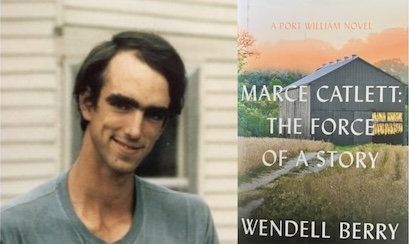
Wendell Berry, John’s oldest son, recently published his father’s story: Marce Catlett: The Force of a Story. This was the story that Mr. Berry had told me several times. Wendell writes of his father, and then of himself [with his fictionalized name Andy]: “Because of the story, there were … certain things that he had to do. Andy and his children have been similarly limited and prompted by this story, [which is] revealed to its followers only by love for those they follow, for one another, and by the daylight as it comes.” 

Because Mr. Berry chose me to mentor, his story became part of my story too, evolving through the years as I worked with farmers and food companies and everyone else in the complex system we call “agriculture.” We’ve had to evolve the story in the wake of recurring challenges. New Deal programs succumbed to global markets. Tobacco was diagnosed as a deadly drug. And Henry County Kentucky is a ghost of the community that used to be. But we still work for “the daylight as it comes,” believing in our hearts that the land and its people are endlessly redeemable.

Mr. Berry’s story lives alongside a story that blossomed in the 1950s with aspirations for free market efficiency but proceeded to grow not only productivity but also ecological and social damage. A new story for the 21st century blends New Deal aspirations for the common good with restoration of the countryside.

The current evolution of “regenerative agriculture,” rooted in practices that restore the biological health of soil, is spreading past a few innovators to their mainstream neighbors. This evolution into a new phase of agriculture requires local learning and trusted advisors. If complemented by markets and policies that reduce financial pressures, rural communities have the potential to bridge “red” and “blue” cultures as farmers launch a second “green revolution.” 
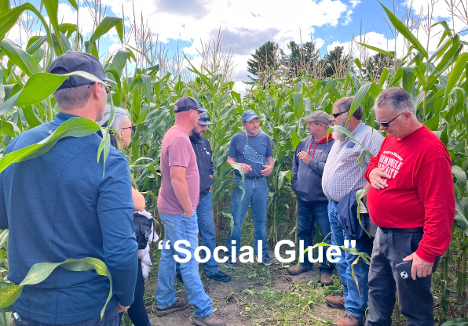
A Second Green Revolution Is Fertilized by Social Glue Among Farmers

Not long ago I visited farmers in Wisconsin, where 50 producer-led watershed groups are re-creating community as they share their steps toward regenerative agriculture. Their enthusiasm contrasts with the depression and suicides that haunt many farming communities. 

A second green revolution rooted in soil health depends on three legs: biology, money, and culture. Culture is frequently neglected. 

Dani Heisler, who manages the Wisconsin program, describes the essence of local groups as “social glue” that has developed as farmers renew each watershed. Such mutuality among farmers used to be widespread but has diminished.

Many years ago, I rounded a corner on my tractor in front of Mac’s Filing Station and a hen bounced out of my hay baler, squawking as if the sky were falling. The old men on the loafer’s bench in front of Mac’s had a story to tell. Everywhere I went for weeks, someone would come up and ask with a chuckle, “Hal, have you found your chicken yet?” The old hen had been setting a next of eggs in the baler, which had been parked in a barn for the winter.

We were a community. When I applied for my annual operating loan, my local banker paid scant attention to the forms I had filled out but instead asked about my kids. Now Mac’s filling station and its loafers’ bench are gone. So is the wood stove at the machinery dealer, around which we’d swap stories in the winter. Hundreds of farms have been replaced by a few dozen. The bank was bought out.

I could give a eulogy at Henry County’s funeral, a remembrance of neighbors working together. A eulogy is usually sad, and I have long been sad, but now I see how this eulogy could give way to vision.

Wendell Berry and his extended family were neighbors and friends of mine in Kentucky. Many of Wendell’s books can be read as eulogies, but their power is in their sense of possibility. I quote the following from Wendell’s 2012 Jefferson Lecture for the National Endowment for the Humanities:

“For humans to have a responsible relationship to the world, they must imagine their places in it. …As imagination enables sympathy, sympathy enables affection. And it is in affection that we find the possibility of a neighborly, kind, and conserving economy. … Of the land-community much has been consumed, much has been wasted, almost nothing has flourished.

…But this has not been inevitable. We do not have to live as if we are alone.”

A second green revolution based on soil health is emerging. Change in farming practices is slow because the risks are high. The process is not overnight. Dani Heisler and the Wisconsin farmers in watershed groups are taking one step at a time, not only innovating on the land but also creating a “social glue” among one another. They learn as they solve problems, supported by trusted advisors and modest financial support, and they’re doing this together in each local area.

A new institutional infrastructure underpins the transition, including state support and a recent investment from Nestle/Purina. These initiatives require money and elbow grease.

Not always right but never in doubt

2025

I sometimes find myself caught up in clever certainty, and I’m not alone. Not always right but never in doubt.

My field of work is agriculture. I recently heard an iconic regenerative farmer comment that most farmers’ soil compaction problem is “the compaction between their ears.” No wonder he’s a lousy mentor for farmers just getting started on this journey. Disdain is the enemy of community, and community is essential to system change.

One of my favorite agronomist leaders told me that “farmers just need to join a new church.” As I thought about this, I realized that virtually nobody responds to entreaty from others to join a new church.

I’ve spent more than twenty years nudging and supporting sustainability professionals in food companies. They’re not always able to do what they wish they could do. But it doesn’t help for them to be hounded by social media nags who are never curious about the constraints within which others are bounded.

I was once working on federal legislation on behalf of a national coalition of farmers. I met with my Senator in Washington, and I thought I heard him agree to support what we were doing, but a few weeks later he voted against it. I blasted off an op-ed to the newspaper accusing the senator of hypocrisy. The next morning, I got a call from a friend who was my most important partner, the state senate majority leader, who told me I was foolish to have squandered this relationship in a fit of pique.

I can still be self-righteously indignant, and I know how to clothe indignance in the superiority of “knowing.” Sometimes this comes across as professorial arrogance. I want so much for people around me to be able to think in systems, understand feedback loops, and be relentlessly curious. All good capabilities, of course, but never developed in the face of disdain. People only grow within a container of respect.

Certainty and the ideological mind are viruses. Curiosity and community are antibiotics. Let’s create a shared story through damage to health.

Soil Under Our Feet

Written in 2017 with Elizabeth Reaves: In short, you could say that systems leaders tend to the “soil” of the social field. Just as soil on a farm contains a web of microbial and bio-chemical interactions, the soil of the social field contains the web of relationships among farmers, businesses and governments, and the sharing of knowledge among farmers that enables them to support each other’s appetites for innovation. It’s our belief that the earth’s soil will be healthy when the social soil is capable of seeing, aspiring and acting for the health of the whole. But what exactly does it look like to aspire and act from the health of the whole?

To take just one perspective, the corporate perspective, it might look like this: companies will need to move from a least-cost approach to a true cost-shared value approach wherein they internalize the risks of the current system and share costs and risks with supply chain partners.

Hitting targets while missing the point

Written in 2017: A senior sustainability leader commented the other day that sustainable sourcing programs might be in danger of hitting their targets while missing the point. As sustainability is operationalized, we might be in the weeds of compliance and lose sight of larger goals.

Sustainable sourcing generally requires asking suppliers to complete self-assessment questionnaires that can be spot checked and thereby verified. Unilever has its own code, as does Pepsi, and SAI Platform has created the industry standard “Farmer Sustainability Assessment.” Some companies ask that farmers enter data into a calculator rather than completing a practice questionnaire, and calculator results can contribute to a baseline of current practices and impacts. A few companies combine a quantitative calculator with a practice-based checklist.

The industry has come a long way from the times when sustainability was marginal or a feel-good greenwashing exercise. Nevertheless, it’s useful to ask ourselves the question our colleague asked, “Are we hitting the targets but missing the point?”

Why We Need Metrics and Why Metrics Are Dangerous

With John Johnson (University of Arkansas) and Peter Senge, we wrote in December 2009: All learning involves assessment. Unless a person, group, or organization can gauge how they are doing relative to an aim, no learning is possible. Such assessment often is aided by quantitative measurement, especially when many people and even many different organizations are involved. But the goal is the learning, the improvement in outcomes achieved and building capacity for further improvement, not the measurement itself. Confusing ends and means leads to the naïve belief that metrics alone produce change, can lead to disappointing results from serious effort to improve metrics and can even make matters worse, such as when people spend time and resources improving metrics at the expense of confronting underlying problems and building healthier systems, or equally problematic, making important decisions based on sophisticated metrics but insufficient or inaccurate information.