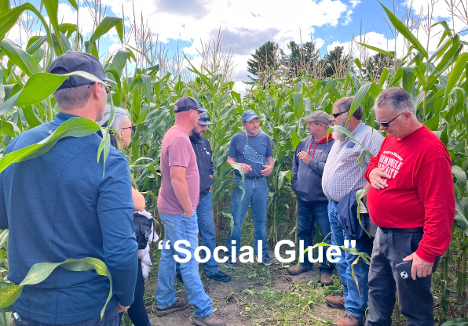
Not long ago I visited farmers in Wisconsin, where 50 producer-led watershed groups are re-creating community as they share their steps toward regenerative agriculture. Their enthusiasm contrasts with the depression and suicides that haunt many farming communities.
A second green revolution rooted in soil health depends on three legs: biology, money, and culture. Culture is frequently neglected.
Dani Heisler, who manages the Wisconsin program, describes the essence of local groups as “social glue” that has developed as farmers renew each watershed. Such mutuality among farmers used to be widespread but has diminished.
Many years ago, I rounded a corner on my tractor in front of Mac’s Filing Station and a hen bounced out of my hay baler, squawking as if the sky were falling. The old men on the loafer’s bench in front of Mac’s had a story to tell. Everywhere I went for weeks, someone would come up and ask with a chuckle, “Hal, have you found your chicken yet?” The old hen had been setting a next of eggs in the baler, which had been parked in a barn for the winter.
We were a community. When I applied for my annual operating loan, my local banker paid scant attention to the forms I had filled out but instead asked about my kids. Now Mac’s filling station and its loafers’ bench are gone. So is the wood stove at the machinery dealer, around which we’d swap stories in the winter. Hundreds of farms have been replaced by a few dozen. The bank was bought out.
I could give a eulogy at Henry County’s funeral, a remembrance of neighbors working together. A eulogy is usually sad, and I have long been sad, but now I see how this eulogy could give way to vision.
Wendell Berry and his extended family were neighbors and friends of mine in Kentucky. Many of Wendell’s books can be read as eulogies, but their power is in their sense of possibility. I quote the following from Wendell’s 2012 Jefferson Lecture for the National Endowment for the Humanities:
“For humans to have a responsible relationship to the world, they must imagine their places in it. …As imagination enables sympathy, sympathy enables affection. And it is in affection that we find the possibility of a neighborly, kind, and conserving economy. … Of the land-community much has been consumed, much has been wasted, almost nothing has flourished.
…But this has not been inevitable. We do not have to live as if we are alone.”
A second green revolution based on soil health is emerging. Change in farming practices is slow because the risks are high. The process is not overnight. Dani Heisler and the Wisconsin farmers in watershed groups are taking one step at a time, not only innovating on the land but also creating a “social glue” among one another. They learn as they solve problems, supported by trusted advisors and modest financial support, and they’re doing this together in each local area.
A new institutional infrastructure underpins the transition, including state support and a recent investment from Nestle/Purina. These initiatives require money and elbow grease.
 Hal Hamilton